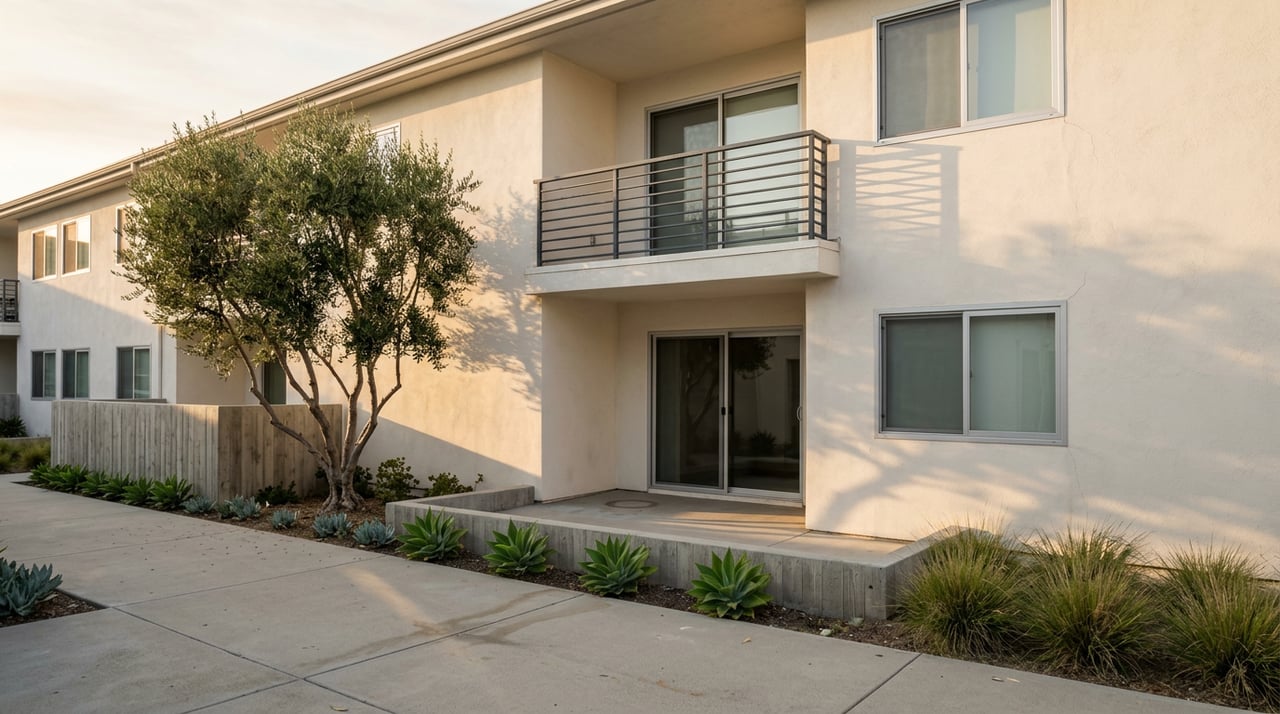
You are standing in a light-filled two-bedroom in a 1962 building a few blocks off Montana Avenue. The listing says condo. Your agent's first instinct, and probably yours, is that condos in California are exempt from local rent control under state law, as the Santa Monica Rent Control Board's 2023 Annual Report explains. That instinct is correct about ninety percent of the time in Santa Monica. It is the other ten percent that can turn a straightforward purchase into a much longer conversation with the city's Rent Control Board.
The City of Santa Monica's TORCA page places the Tenant Ownership Rights Charter Amendment, or TORCA, in the 1984–1996 period, and the building was very likely converted from apartments to condominiums sometime during that period. A 2023 evaluation cited by the Santa Monica Housing Commission put the share of eligible tenants who actually purchased at around seven to twelve percent, depending on the study. Everyone else stayed on as a renter, in a building that is now legally a condominium, in a unit that may still be governed by the same Rent Control Charter that covered it before conversion.
That is the wrinkle worth understanding before you write an offer.
The condo exemption is not automatic. It's conditional.
California's Costa-Hawkins Rental Housing Act, passed in 1995, is the reason most condos and single-family homes across the state escape local rent control. But the exemption in Santa Monica has three conditions attached, not one. A unit is exempt only if it is separately alienable, has been sold for value, and is either vacant, owner-occupied, or occupied by a tenant whose tenancy began on or after January 1, 1996.
That last clause is where TORCA buildings diverge from ordinary condo conversions. If the current occupant moved in before that date and has lived there continuously since, without a voluntary vacancy in between, the unit has never triggered the event that would decontrol it. The condo label on the deed does not change that. Santa Monica's own Rent Control Board tracks it unit by unit, and a tenancy that predates 1996 and has never lapsed stays inside the Charter's jurisdiction regardless of who holds title.
Put simply: exemption is a fact about the tenancy's history, not a fact about the property type.
What the Board's own numbers show
This is not a theoretical edge case. The Rent Control Board's most recent annual report puts the number of TORCA-converted condominiums that could, in principle, clear the Costa-Hawkins bar at close to 3,100 units. Citywide, just over 1,800 condominiums and single-family homes have actually cleared it, and the Board notes most of those are owner-occupied. The gap between those two figures is the whole point. A TORCA unit does not decontrol itself the moment ownership changes. It decontrols only when a specific, documentable event happens: the unit sits vacant, the buyer moves in and the prior tenant has left, or the resident tenant's occupancy started on or after January 1, 1996.
Until one of those events occurs, the unit keeps its Maximum Allowable Rent, keeps its annual General Adjustment, and keeps its just cause eviction protections, exactly as if the building had never converted.
Three units, three very different outcomes
The same TORCA building can contain units in completely different legal positions, depending only on who has lived there and for how long.
| Unit occupancy history | Rent control status | What it means for a buyer |
|---|---|---|
| Vacant at time of sale | Exempt under Costa-Hawkins | Buyer should confirm possession details before making an offer |
| Tenant moved in on or after Jan 1, 1996 | Exempt under Costa-Hawkins | The unit itself is not rent-controlled |
| Tenant moved in before Jan 1, 1996, tenancy never lapsed | Still governed by the Rent Control Charter | Tenant retains just cause protections; buyer inherits controlled rent and eviction rules |
Three condos in the same building, at the same price per square foot, can carry three entirely different sets of obligations. Nothing in the exterior, the HOA documents, or the listing photos tells you which one you are looking at.
Where the answer actually lives
The good news is that this is not a guessing game. Registered units generate an annual Report of Maximum Allowable Rents that lists, among other things, the date the current tenancy began. The Santa Monica process explainer says owners of registered units receive this report by mail each year, and it is the fastest way to settle the question definitively, faster than any assumption based on the building's age or the word "condo" in the MLS remarks.
Before writing an offer on any Santa Monica condo with a tenant in place, it is worth asking directly: is this unit registered with the Rent Control Board, and does the current Report of Maximum Allowable Rents show a tenancy that began before or after January 1, 1996. That single date resolves most of the ambiguity.
If the tenant is protected and you want to move in
If the unit turns out to still be governed by the Charter, and you intend to occupy it yourself rather than keep it as a rental, removing a protected tenant is not a matter of simply closing escrow. Santa Monica's just cause eviction framework applies, and no-fault removals carry mandatory relocation payments. Favia Investment Group's Santa Monica rent control guide puts documented base relocation payments for no-fault removals in Santa Monica at roughly $23,000 to $24,000 per unit as of early 2026, with additional amounts required for tenants who are elderly, disabled, or part of a household with school-age children. Those figures come from current guidance for Santa Monica property owners and are worth confirming with the Rent Control Board directly before you count on a specific move-in date, since procedural notice requirements and dollar amounts are adjusted periodically.
This is the detail that catches buyers off guard most often. Buyers should ask about possession before proceeding rather than assume a unit is a straightforward owner-occupant purchase.
One more number worth knowing if the unit stays a rental
If you are buying with the intention of keeping the current tenancy in place, either as an investor or simply because that is the path of least friction, the Rent Control Board's Resolution 26-001 sets the next General Adjustment at 2.6 percent, effective September 1, 2026, with a ceiling of $70 per month on units at higher rent levels. That is the entire allowable increase for the year on a controlled unit, regardless of what comparable market rents are doing three blocks away. Anyone running numbers on a TORCA condo as a rental should model income against that cap, not against Santa Monica's broader rental market, which is not the same thing.
What this changes about how you should shop
None of this means TORCA-era buildings should be avoided. Many of these buildings sit in some of the most walkable parts of Santa Monica, close to Montana Avenue, Wilshire Boulevard, and the Ocean Park corridor, and they often price below newer construction on a per-square-foot basis. The point is narrower than that. The condo label tells you about title. It tells you nothing about the tenancy inside, and in this city those are two separate questions with two separate answers.
If you are comparing a TORCA-era unit against a newer building or a single-family home elsewhere on the Westside, our guide to Santa Monica condos versus homes walks through the broader lifestyle tradeoffs. If financing is the next question on your list, our overview of jumbo loan basics for Santa Monica buyers covers what changes above conforming loan limits. And if you want the full neighborhood picture before you start touring, our Santa Monica neighborhood guide is a good starting point.
A few questions buyers ask
Does every older condo in Santa Monica have this issue? No. Many older condos were never part of TORCA at all, and many TORCA units have already cleared the decontrol bar through a vacancy or owner occupancy. The only way to know for a specific unit is to check its registration status and the current tenant's move-in date.
Can the seller just tell me the unit is exempt? A seller's representation is a starting point, not a substitute for the Board's own record. The Report of Maximum Allowable Rents, or a direct inquiry to the Rent Control Board, is the documentation that actually settles the question.
What if I plan to rent the unit out rather than live in it? Then the unit's controlled or exempt status still matters, because it determines whether you can set your own rent or whether you inherit the existing Maximum Allowable Rent and the annual General Adjustment schedule, currently 2.6 percent effective September 1, 2026.
Questions like these are exactly where a second set of eyes earns its keep before you are three weeks into escrow. If you are weighing a Santa Monica condo and want to talk through what a specific building's history actually means for your offer, Tessa Cosentino would be glad to help you sort it out. Let's Chat, schedule a time to connect, and we'll look at the details together before you commit to anything.
This article is general information, not legal, tax or financial advice. Consult a qualified professional about your situation.